Context
My master's degree — Leadership in Digital Innovation at the Berlin University of the Arts — kept returning to one theme: transparency. Transparency in organisations, in projects, in processes. The most uncompromising expression of that idea is open source software, so that is where I went looking.
Open source is a remarkable thing. Countless individuals and businesses around the world freely donate their time and ideas to keep the ecosystem alive, and much of the internet's back-end and infrastructure runs on the result. Yet open source has long struggled the moment it meets an end user. Consumer-facing open source projects are rare, and even when they exist they seldom offer an experience anyone would call delightful — functionally a match for their commercial counterparts, but rarely as usable.
I wanted to find practical starting points for this development-driven culture to build more user-friendly software — and, in doing so, help open source stay alive and thriving.
The Question
Around this time, design systems had emerged as a way to improve collaboration between designers and developers and to raise the baseline of usability. They seemed a natural fit for open source: a shared, documented platform that distributed contributors could build against without endless coordination.
The thesis set out to understand how design systems are actually used in open source today, and where there is room to adopt them further.
Approach
Academic research on the impact of design systems is thin, and on design systems in open source specifically, thinner still. That gap called for a qualitative, exploratory approach.
I interviewed six designers working in open source — each based in a different country — whom I recruited through Twitter and the Open Source Design community. The interviews followed a problem-centred interview (PCI) method — a format that balances structured questioning with open narrative, and one that suits subjects that have barely been charted. I then transcribed every interview in full and coded them in detail in MAXQDA, looking for the patterns that recurred across participants and the projects they described.
Findings
The decisive finding was that the obstacle is less about tooling than about culture and standing.
Designers in open source still face significant barriers. They are often not taken seriously — treated as aestheticians rather than as integral members of the development process. Contributing is structurally harder for them than for engineers: the community primarily rewards code, and many designers cannot implement their own work, which makes their contributions harder to measure and their reputation harder to build.
Design systems could lower that barrier to entry, giving designers and developers a shared platform to meet on. But establishing and maintaining one depends on strong design leadership, which is only rarely present in open source projects. And there is no standardised way to use design systems in open source in the first place — because there is no shared definition of what a design system even contains. How such a system should be designed, built, and governed to sustain open source software remains an open question.
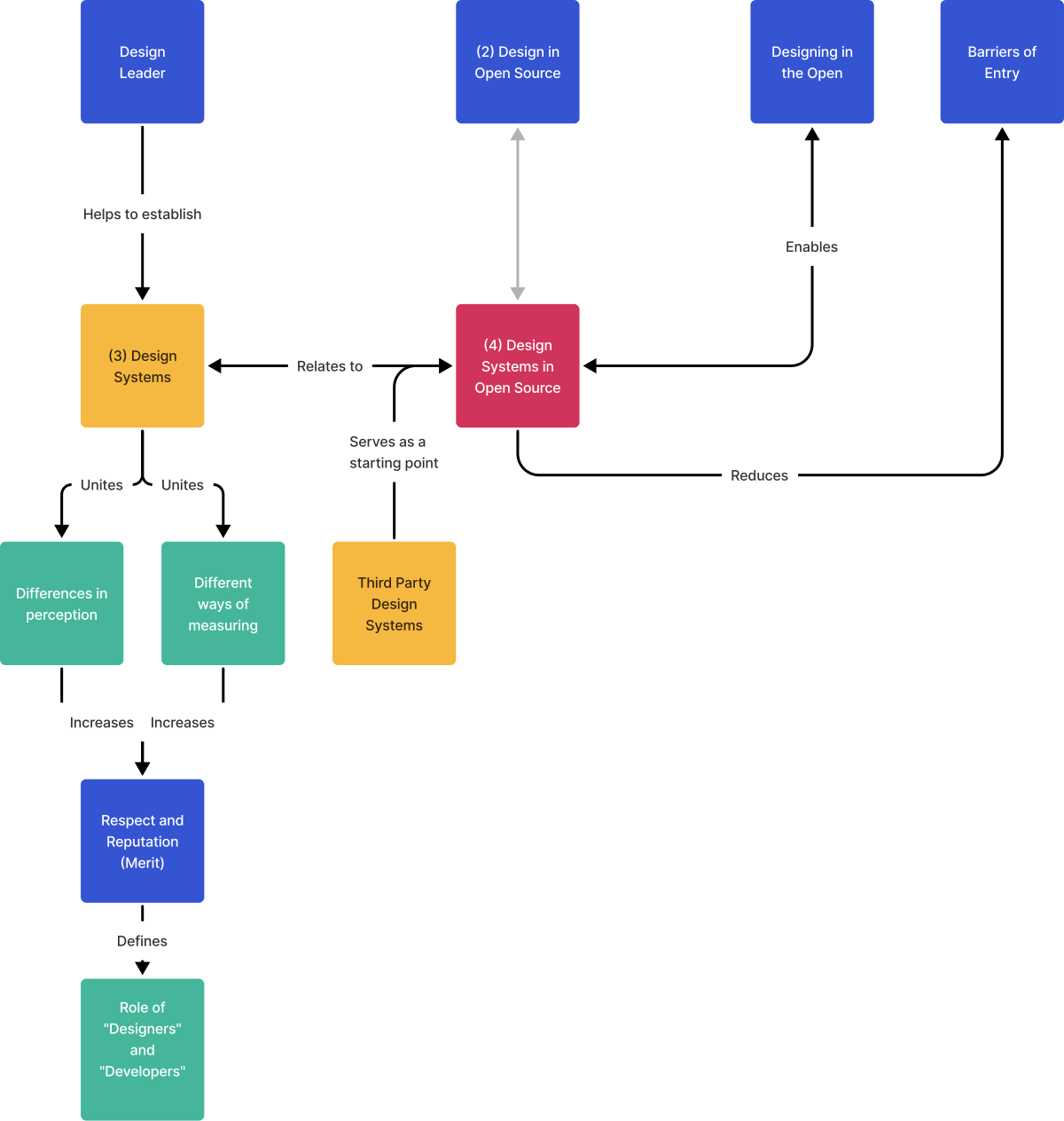 Diagram summarising the thesis findings on designers and design systems in open source
What I Took Away
I am still convinced that design systems could help the open source community at large. But anyone who has built and maintained one knows where the difficulty actually lies: not in producing practical, beautiful components, but in the politics. That is hard even inside organisations with clear hierarchies and chains of command — and harder still in a volunteer community with neither.
My pragmatic recommendation is to start by adopting a third-party design system. It removes much of the need for detailed design debate early on; once a project has a solid base, building something custom may begin to make sense.
From a purely academic standpoint, the thesis was at times genuinely difficult to write — and rewarding for the same reason. Proper research into the impact and value of design systems is still scarce, and the connection to open source was novel territory worth charting.